The Global Flourishing Study Is Now a Global Resource

Updated: Jun 15
A brief update on open data, global research, public engagement, and the next phase of the world’s largest longitudinal study of human flourishing
When the Global Flourishing Study launched, it was already ambitious in scale: a five-year longitudinal study of more than 200,000 people across 22 geographically and culturally diverse countries, designed to better understand what helps people and societies flourish.
Receive Tyler's monthly insight and research updates from the Human Flourishing Program team.
But the Global Flourishing Study was never intended to be only one publication, one dataset, or one launch event. It was designed as a long-term research resource: a way to study human flourishing across cultures, across time, and across many dimensions of life, including happiness, health, meaning, character, relationships, material stability, community, and more.

One year after the public launch of the first wave of findings, that broader vision is beginning to take shape. The study has already generated a large body of scholarship, made major datasets available for use by researchers around the world, contributed to public conversations about the future of well-being, and opened up new possibilities for understanding flourishing not only through survey data, but through in-depth interviews that will capture participants’ own descriptions of their lives.
A new global research resource
One of the most important goals of the Global Flourishing Study is open science. The study is not only producing findings from its core research team. It is also creating a public data resource for independent scholars, journalists, educators, policymakers, and other researchers interested in understanding human flourishing.

Data from Waves 1, 2, and 3 are now available through the Center for Open Science, along with supporting materials to help researchers understand and use the data responsibly. These resources include codebooks, methodology reports, survey documentation, translation materials, preregistration guidance, and other tools that make the study more accessible and transparent.
This matters because flourishing is not a narrow topic. It cannot be understood fully through one discipline, one country, one cultural context, or one kind of outcome. The Global Flourishing Study includes questions related to many aspects of human life, from mental and physical health to meaning and purpose, relationships, character, financial security, religious and spiritual life, childhood experiences, social support, and civic and political context.
By making these data available, the study creates an infrastructure for many more questions to be asked. Researchers can examine how different aspects of life relate to one another, how patterns vary across countries, and how changes over time may shape later well-being.
Research output has already exceeded expectations
The study has also generated a substantial body of academic work. To date, the core team has published 85 papers on the Global Flourishing Study, most of them using Wave 1 data. Many of these papers are part of the Nature-Springer Special Collection, which already includes 67 papers and continues to grow.

This publication record is significant for several reasons. First, it shows that the study is not a single research article, but a large-scale platform for sustained scholarship. Second, the papers cover many different topics, reflecting the multidimensional nature of flourishing. Third, the research has been made broadly accessible through open access publication wherever possible.
The work is continuing. In addition to the papers already published, at least 75 further papers have been submitted to journals by the team. Additional papers are also being produced by researchers outside the core team, using Global Flourishing Study data to examine new questions and contexts.
In other words, the study is already doing what it was designed to do: generating a field of inquiry around flourishing that extends beyond any one research group.
Researchers are using the data
Open data only matters if people use it. Early signs suggest strong engagement.
As of May 20, 2026, shortly after Wave 1 and Wave 2 data were made publicly available, the Global Flourishing Study data had already been downloaded over five hundred times. Wave 3 data, which require preregistration, had been sent to over one hundred preregistrations.
The Global Flourishing Study Registry also shows substantial use. It includes over three hundred preregistrations, with many linked to data, code, preprints, or publications. This kind of structure helps support more transparent research practices by connecting proposed analyses with the data and outputs that follow.
For a study of this scale, that kind of early uptake is important. It means the Global Flourishing Study is beginning to function not only as a set of findings, but as a shared research platform.
The findings have entered public conversation
The Global Flourishing Study has also reached audiences beyond academia. Since the April 2025 launch event at Gallup headquarters, the study has received nearly 4,000 mentions across print, online, and broadcast media, including more than 1,400 media articles and two pieces in The New York Times.
The study’s public-facing platforms have also seen strong engagement. The Global Flourishing Study website has had over 15,000 users this past year, and the main trailer video has received more than 328,000 views on YouTube. Global Flourishing Study content has also performed strongly on LinkedIn, including posts that have reached hundreds of thousands of impressions.
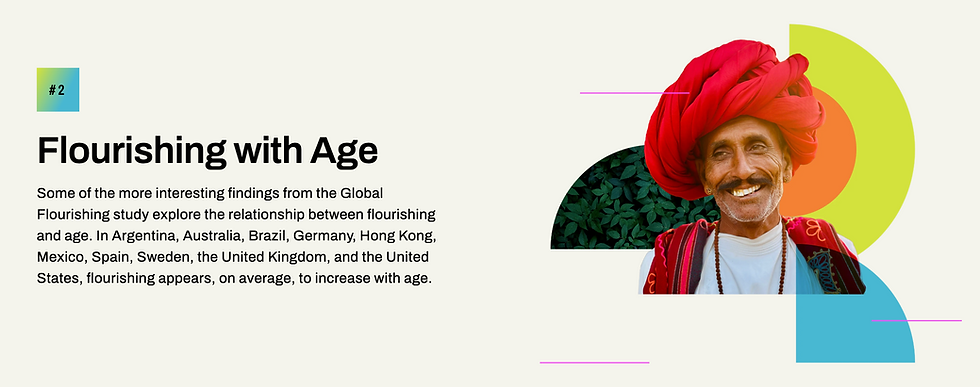
This kind of public attention is encouraging, but it also brings responsibility. Flourishing is a topic people care about deeply, and the public conversation around it can easily become simplistic. The study’s contribution is to bring better evidence to that conversation.
It invites more careful questions: What does it mean for a society to flourish? Why might some countries do better in one domain of life but worse in another? Why are younger adults struggling in many countries? How do meaning, relationships, religion, work, family, education, health, and economic security interact over time? What can longitudinal evidence tell us that cross-sectional studies cannot?
The value of the Global Flourishing Study is not that it offers one simple answer. Its value is that it gives researchers, leaders, and communities a richer way to ask better questions.
A more complete picture of flourishing
One of the central insights behind the study is that well-being cannot be reduced to a single measure. Life satisfaction matters, but it is not the whole of flourishing. Income and financial security matter, but they do not capture everything people need to live well. Mental health matters, but flourishing also includes meaning, relationships, character, physical health, and the broader contexts in which people live.
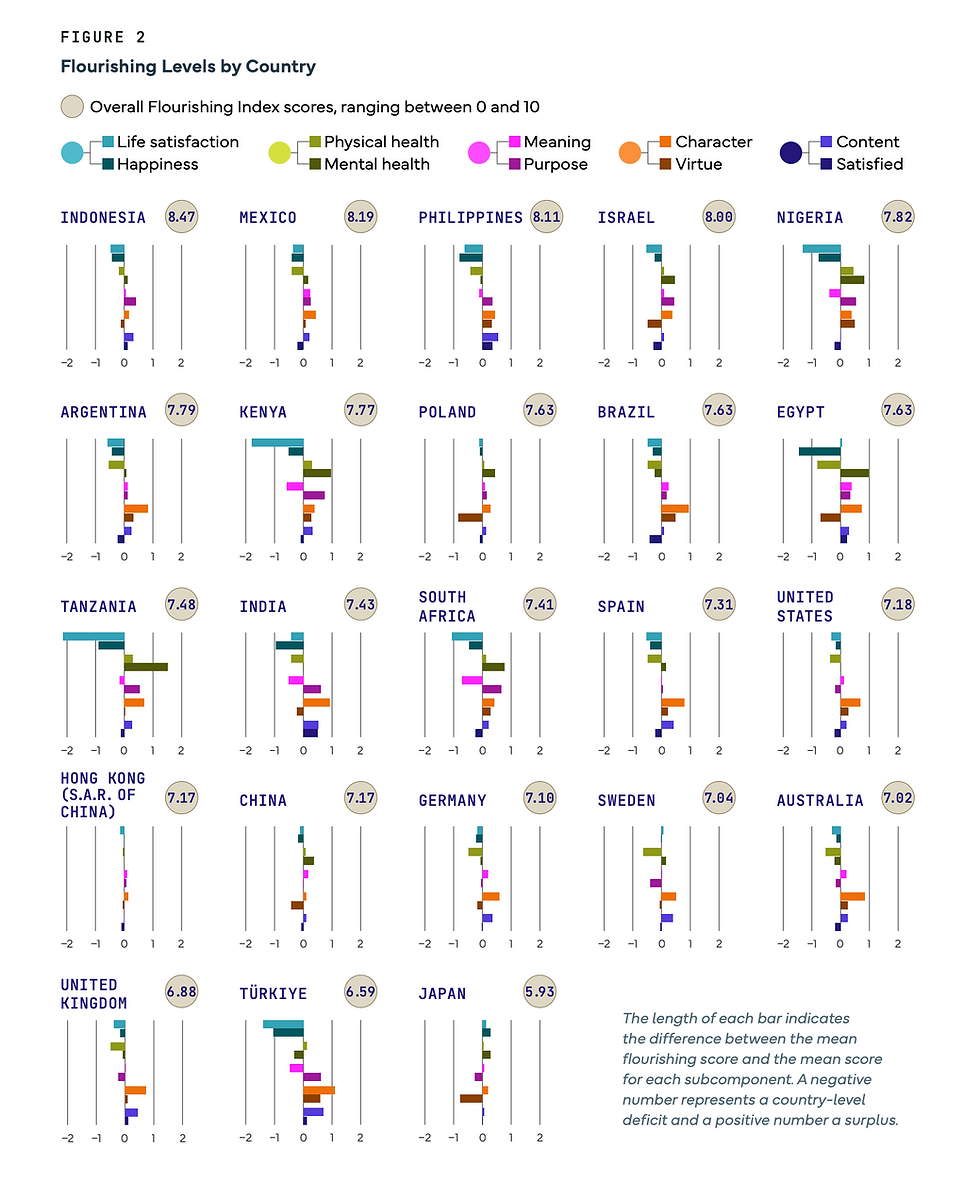
The Global Flourishing Study is helping make this multidimensional view more visible. In many countries, young adults are struggling not only with mental health, but also across other aspects of flourishing. At the same time, the data suggest that economically developed countries do not always score highest on dimensions such as meaning, relationships, or character.
These findings complicate familiar assumptions about progress and well-being. They also point to the need for a broader public conversation. If societies measure only economic growth, they may miss other important aspects of human life. If they measure only happiness or life evaluation, they may miss meaning, relationships, and virtue. If they focus only on problems, they may fail to understand the conditions that help people live well.
The Global Flourishing Study offers a wider lens.
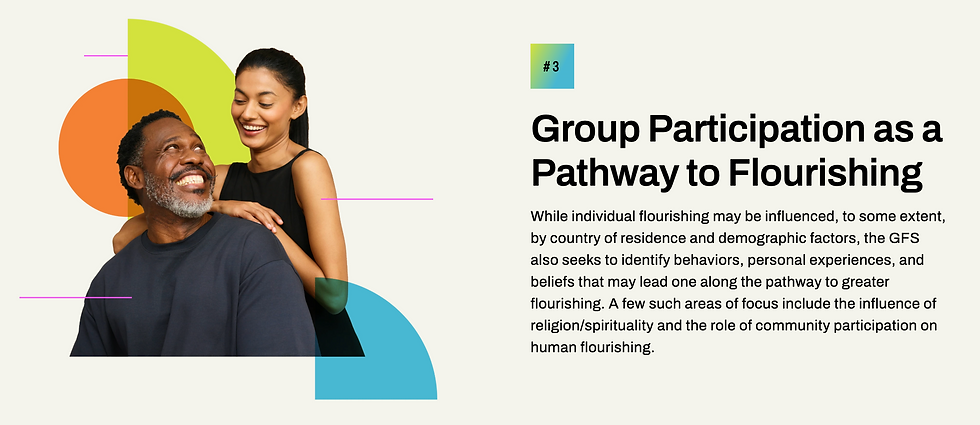
What comes next
The next phase of the study will continue to deepen this work. Researchers are now analyzing and writing papers using Wave 2 and Wave 3 data, with many more publications expected. Wave 4 data collection and future analyses will further strengthen the study’s ability to examine changes in flourishing over time.
The team is also developing new ways of understanding flourishing beyond standard survey responses. One emerging effort will use AI-assisted in-depth interviews with approximately 3,000 Global Flourishing Study participants in the United States. This approach will allow researchers to connect quantitative data with participants’ own descriptions of their lives, giving a richer picture of what flourishing means in practice. Similar smaller efforts are also being explored in Sweden and Japan.
Another public-facing effort is a Global Flourishing Study documentary. In May 2026, a film crew traveled to Sweden with the GFS project manager to interview people about flourishing and their lives in Sweden. Additional interviews are planned, with the goal of developing a short documentary film for a future Wave 2/3 launch event, and the possibility of a longer documentary series.
These next steps reflect a larger point: the study is still unfolding. The first wave gave an initial picture. Later waves will allow researchers to ask stronger questions about change over time, possible determinants of flourishing, and how patterns differ across countries and cultures.
Why this matters
The Global Flourishing Study is built around a simple but far-reaching premise: what we measure shapes what we notice, what we study, what we discuss, and what we try to improve.
If we want to better understand human life, we need better ways to measure more of what matters. We need data on health, but also meaning. We need data on financial security, but also relationships. We need data on individuals, but also the communities and contexts in which they live. We need evidence from many countries and cultures, not only from a narrow set of high-income societies.
The Global Flourishing Study is helping build that foundation. Its early progress suggests that the study is becoming what its founders hoped it would be: a global resource for understanding the conditions under which people and societies flourish.
That work is still in progress. But the first stage has already made one thing clear: a richer science of human flourishing is now possible.
Receive Tyler's monthly insight and research updates from the Human Flourishing Program team.


