Global Forgiveness Movement

Updated: Oct 14

Join our network to receive emails about
upcoming programs and resources.
The Global Forgiveness Movement at the Human Flourishing Program uses evidence-based interventions to make the world a more loving and forgiving place. |  |
Latest Forgiveness Research |

How common is forgiveness?
In this article, we use Global Flourishing Data to show how forgiveness varies across different countries and contexts.
What factors lead to forgiveness?
In this article we explore childhood factors that could lead to higher or lower levels of forgiveness in adulthood.

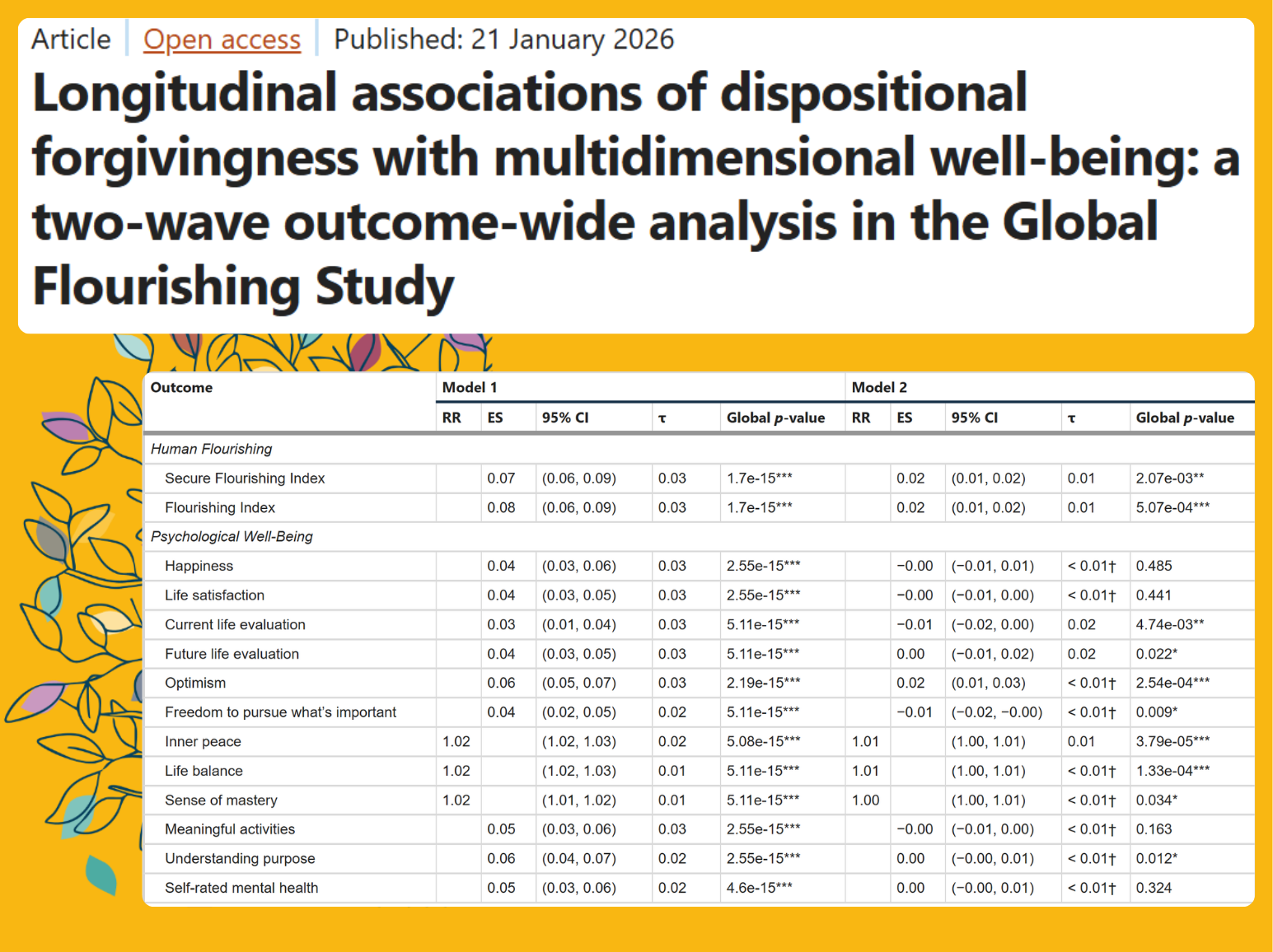
Is forgiveness good for us?
In this article we show that forgiveness plays a significant role in promoting flourishing across many dimensions of well-being, including mental and physical health.
What is Forgiveness? | |
We define forgiveness as replacing ill will with goodwill to those who have wronged us: | |
 | This means desiring the flourishing of the offender, but without necessarily forgetting the harm. |
| Forgiveness is compatible with accountability, truth, and justice. |
| Forgiveness does not necessarily mean reconciling with the offender because some relationships should not be restored; some relationships are toxic and need boundaries. |
| Forgiveness requires a two-fold movement: 1) a decision to forgive, and 2) replacing negative emotions towards the offender with more positive emotions. |
Should we forgive? | |
Our research shows that forgiveness is good for individual and communal health: | |
| Forgiving those who have harmed us leads to flourishing because it allows us to let go of negative feelings that can undermine our health and well-being. |
| Forgiveness lowers depression and anxiety. |
| Forgiveness can, over time, help free one from rumination and hurt. |

What is the REACH Model of Forgiveness? | |
Psychologist Everett Worthington’s REACH Forgiveness model is one of the most widely tested models of forgiveness, and is synthesized in Do-It-Yourself workbooks. REACH stands for: | |
 | Recall the interpersonal hurt and the emotions associated with it. |
 | Try to empathize with the offender. |
 | Explore the idea that forgiveness can be seen as an altruistic gift to the offender. |
 | Make a voluntary commitment to forgive. |
 | Seek to hold onto or maintain forgiveness through difficult times. |
Does the REACH workbook actually promote forgiveness and well-being? | |
The REACH Workbook is an evidence-based resource that anyone can benefit from. The Human Flourishing Program was involved in comprehensively testing the workbook in a randomized controlled trial with over 4500 participants across 5 relatively high conflict countries: Colombia, South Africa, Ukraine, Indonesia, and Hong Kong. The results of our research indicate that the workbook is effective in: | |
 |  | increasing forgiveness | |
 | reducing anxiety and depression | ||
 | increasing hope, and | ||
 | increasing flourishing | ||

Get Involved
Join our Forgiveness Community of Practice | |
| Meets on Zoom at 12pm ET the first Friday of every month starting September 4. |
| Learn about forgiveness research, forgiveness implementation best practices, and connect with others interested in spreading forgiveness. |
Apply to join our Late Summer Forgiveness Group | |
| Through Forgiveness Groups, participants work through Everett Worthington's evidence-based REACH Forgiveness Workbook on their own and then meet with a group to discuss the experience of working through the workbook. The group setting provides support, community, and accountability. |
| This group will meet 3 Tuesdays on Zoom over August and September 2026 (8/25, 9/1, and 9/8). |
| Each meeting will be online from 1pm-2:30pm ET and will require 1-2 hours of preparation work. |
Forgiveness Resources



References
Chen, Y., Harris, S. K., Worthington Jr, E. L., & VanderWeele, T. J. (2019). Religiously or spiritually-motivated forgiveness and subsequent health and well-being among young adults: An outcome-wide analysis. The journal of positive psychology, 14(5), 649-658, https://doi.org/10.1080/17439760.2018.1519591
Ho, M.Y., Worthington, E.L., Cowden, R.G., Bechara, A.O., Chen, Z.J., Gunatirin, E.Y., et al. (2024). International REACH forgiveness intervention: a multisite randomised controlled trial. BMJ public health, 2(1), https://doi.org/10.1136/bmjph-2023-000072
Long, K. N., Worthington Jr, E. L., VanderWeele, T. J., & Chen, Y. (2020). Forgiveness of others and subsequent health and well-being in mid-life: a longitudinal study on female nurses. BMC psychology, 8(1), 104, https://doi.org/10.1186/s40359-020-00470-w
Long, K. N., Chen, Y., Potts, M., Hanson, J., & VanderWeele, T. J. (2020). Spiritually motivated self-forgiveness and divine forgiveness, and subsequent health and well-being among middle-aged female nurses: An outcome-wide longitudinal approach. Frontiers in psychology, 11, 1337, https://doi.org/10.3389/fpsyg.2020.01337
Contact Us
For inquiries about the Global Forgiveness Movement, please reach out to Kate Jackson-Meyer at kjacksonmeyer@fas.harvard.edu


